
A burn gel dressing order line should name the format (sachet, pad, sheet, face mask or spray), the dressing size, the gel weight, whether it is packed sterile, and how many units are in the box you are pricing. Two dressings sold as 20 × 20 cm can carry different amounts of gel, and one manufacturer reference can be supplied in boxes of very different counts. Ask for the labelled storage range and the expiry of the offered batch, and have your safety lead approve the formats your kits need.
Start with the format, then the size
Burn care lines in a quotation often look alike: “burn gel”, “burn dressing”, “burn kit”. They cover different things. A single-use gel sachet, a gel-soaked pad, a large sheet, a shaped face mask, a spray and a dry sterile burn sheet are separate products, and a kit refill list should say which one each line replaces.
Write the format first, then the size. “Hydrogel pad, 10 × 10 cm” and “gel sachet, 3.5 g” are separate purchasing lines. Keep sheets and face masks on their own lines if your safety lead has included them in the approved site list; do not infer the required formats from the workplace name alone.
If the request comes from an existing kit, copy the wording on the current item’s label rather than the kit’s contents card. The card may describe a category, while the label shows the actual format and size that your team is used to.
References: AccessGUDID (US FDA device database): Burnshield 10 × 10 cm dressings, model 901111 · AccessGUDID (US FDA device database): Burnshield limb dressing, 50 mm × 1 m
Same size, different gel weight
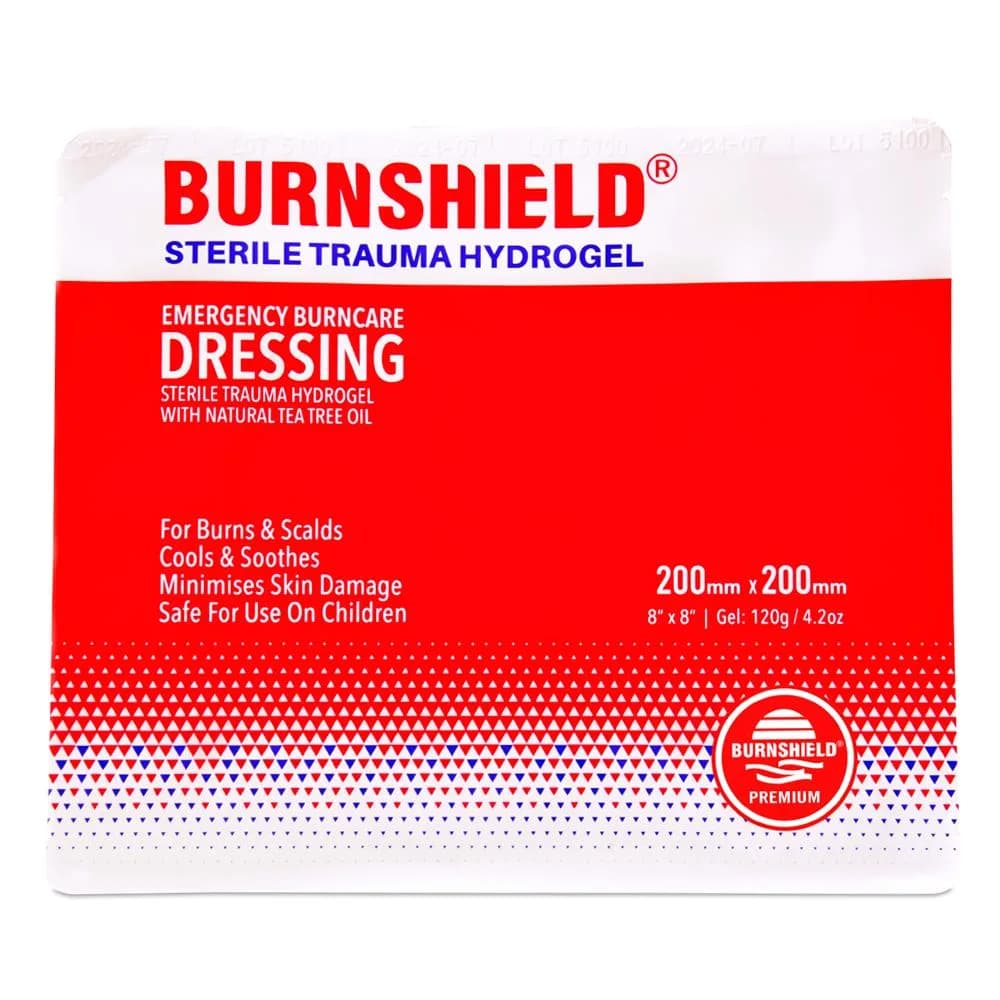
Size alone does not describe a gel dressing. Our catalog photograph of a Burnshield 200 × 200 mm pouch is labelled 120 g of gel, while the generic 20 × 20 cm listing specifies 150 g of gel. Confirm the label of the exact item offered before approving a substitution. Separately, the US device record for Burnshield model 901111 lists 40 g as “Weight”; that field alone does not establish its gel content.
Ask the supplier to state the labelled gel weight next to each size, and keep it in your approved list. The same record shows the Burnshield dressing packaged as sterile and single use, which is the kind of detail to confirm for every line rather than assume from the brand or the word “dressing”.
Shapes matter as well. The database also lists a Burnshield limb dressing, 50 mm by 1 m, under the same device type as the square pads. If your site plan calls for a long limb dressing or a face mask, name the shape on the order instead of asking for “a large burn dressing”.
References: AccessGUDID (US FDA device database): Burnshield 10 × 10 cm dressings, model 901111 · AccessGUDID (US FDA device database): Burnshield limb dressing, 50 mm × 1 m
Check what one unit of the quotation means
Package counts must be read together with the package they contain. In the 10 × 10 cm Burnshield record, package 16007645009741 contains four packages of 06007645009744; each of those contains 60 single dressings. That outer box therefore represents 4 × 60 = 240 dressings, not four dressings. These are database examples; confirm the package identifier actually offered.
Ask for the unit of measure on every line: single dressing, inner pack or outer box, and the count inside each level. Multiply through to single dressings before comparing offers. The limb dressing record has a box of 10 and an outer pack of five such boxes, giving 50 dressings per outer pack.
For multi-site orders, decide whether each site receives whole boxes or loose dressings split from a box. Loose items need their own label with size, lot and expiry, or the receiving site cannot check them against the kit list.
References: AccessGUDID (US FDA device database): Burnshield 10 × 10 cm dressings, model 901111 · AccessGUDID (US FDA device database): Burnshield limb dressing, 50 mm × 1 m
Storage range and expiry of the offered batch
Both database records give a labelled storage range of −10 to 40 °C and flag that lot and expiry are carried on the label. Compare that range with where the dressings will actually be kept, for example a site cabin, a vehicle kit or a store room, and ask your safety lead how to handle locations that may fall outside it.
Ask the supplier for the expiry on the batch being offered, or a minimum remaining period at delivery, rather than a general shelf-life figure. The date printed on a catalog photograph, including the one on this page, is not evidence of what will be delivered.
Record lot and expiry for each site on receipt, so the next inspection can find the dressings that need replacing first.
References: AccessGUDID (US FDA device database): Burnshield 10 × 10 cm dressings, model 901111 · AccessGUDID (US FDA device database): Burnshield limb dressing, 50 mm × 1 m
Worked example: refilling burn items for a kitchen and a workshop
This is an illustrative purchasing exercise, not a clinical recommendation or a MedSphere quotation. A hotel group needs burn refills for a central kitchen and an engineering workshop. The safety lead has approved gel sachets for every first aid box, two square hydrogel pads per kitchen station and one large dressing for the workshop.
The first draft request reads “burn gel x 50”. The buyer rewrites it as three lines: 3.5 g gel sachets with the number of sachets per box; 10 × 10 cm hydrogel pads, packed sterile, with gel weight and dressings per box; and one 20 × 20 cm hydrogel dressing with its gel weight. Each line also asks for the labelled storage range and the batch expiry.
Two offers arrive. One prices the pads per box of 10, the other per single dressing. Once both are converted to dressings and the gel weights are listed side by side, the buyer can see which line needs a substitution decision before approving the order.
Burn gel dressing order checklist
| Field | What to confirm |
|---|---|
| Format | Sachet, pad, sheet, face mask, limb dressing, spray or dry sterile burn sheet, one per line. |
| Size | Labelled dimensions in mm or cm, and shape for limb or face items. |
| Gel weight | Labelled gel weight for each size; note any difference between offers. |
| Sterility | Packaged sterile or not, and single use, as stated on the label. |
| Unit of measure | Single dressing, inner pack or outer box; counts at every level and the resulting total dressings. |
| Storage range | Labelled temperature range compared with where the kits are kept. |
| Batch expiry | Expiry of the offered batch or a minimum remaining period at delivery. |
| Substitution | Who approves a different brand, gel weight or format before dispatch. |
Questions before you order
Is a 20 × 20 cm burn gel dressing from one brand the same as another?
Not necessarily. Gel weight, construction and pack count can differ at the same size. Ask for the labelled gel weight and box count for each offer and have your safety lead approve any substitution.
Should every first aid box have large burn dressings?
That depends on the site’s risk assessment and the responsible safety lead’s approved list. Record the required formats and quantities for each location; do not infer that every box needs the same burn-care items.
How do I compare two quotations for burn dressings?
Convert every line to the number of single dressings, list the size and gel weight side by side, and check that both quote the same format and sterile packing. Only then compare delivery and batch expiry.
Can you quote burn dressings with a kit refill?
Yes. Send the kit model or contents list and the burn items your safety lead approved, and we quote them as separate lines with size, gel weight and pack count confirmed.
Sources & scope
This is a purchasing guide. Your qualified safety lead should confirm the current requirements for your site. It is not a clinical protocol or a compliance certificate.
- AccessGUDID (US FDA device database): Burnshield 10 × 10 cm dressings, model 901111
US device identification record, public version September 21, 2026. Supports dimensions, an unspecified 40 g weight field, sterile/single-use status, storage and label fields, and nested packaging identifiers. Package quantities may count inner boxes rather than dressings. Not Gulf registration or MedSphere availability evidence. Checked 2 November 2026.
- AccessGUDID (US FDA device database): Burnshield limb dressing, 50 mm × 1 m
US device identification record. Used for the limb dressing shape and size, the shared gel-coated burn dressing device type, the −10 to 40 °C storage range and the box of 10 within an outer pack of 5. Not a UAE registration or an offer by MedSphere. Checked 2 November 2026.
Prepared with AI assistance and checked against the cited sources. No clinical reviewer is claimed. Read our editorial policy or send a correction.
Explore the catalog
These products are available for enquiry. Specifications, contents and delivery are confirmed in your quotation.