
Eyewash station requirements start with a hazard: where a chemical could injure someone's eyes, the US rule OSHA 1910.151(c) asks for quick flushing facilities in the work area, and the ANSI/ISEA Z358.1 standard most specifications cite expects a 15-minute tepid flush reachable in about 10 seconds. A kit eye wash bottle does not meet that on its own.
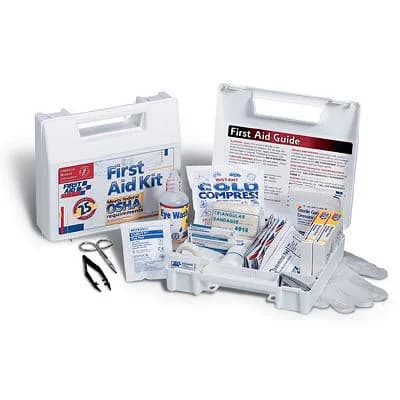
What do eyewash station requirements actually require?
The legal trigger is exposure, not headcount. OSHA's general first aid rule, 29 CFR 1910.151(c), requires suitable facilities for quick drenching or flushing of the eyes and body within the work area where a person's eyes or body may be exposed to injurious corrosive materials. OSHA's letters of interpretation say there is no threshold quantity and no size exemption: the deciding factor is whether an employee could be injured by contact with a corrosive.
The same letters explain that OSHA has not adopted flow rates or design details of its own. It points employers to ANSI Z358.1 as guidance for what 'suitable' looks like. That is why buyers, consultants and contractors in the GCC who write an eyewash specification usually quote ANSI/ISEA Z358.1, even though it is a US consensus standard rather than Gulf law.
For a UAE, Saudi, Qatari or Omani site, the binding requirement comes from the site's own risk assessment, the emirate or national occupational safety rules that apply to it, and any operator or client HSE specification in the contract. Ask your safety lead which document the eyewash has to satisfy before you compare products. A quotation can then be checked against a named standard instead of a sales description such as 'OSHA eyewash'.
References: OSHA letter of interpretation: ANSI Z358.1 guidance for complying with 1910.151(c) (18 April 2002) · OSHA letter of interpretation: Requirements for eyewash and shower facilities (1 June 2009)
What performance does ANSI/ISEA Z358.1 set for an eyewash?
ANSI/ISEA Z358.1-2014 (reaffirmed in 2020) sets minimum performance, installation, testing and maintenance criteria for emergency eyewashes, eye/face washes, showers and combination units. ISEA's selection and use guide (edition 2, August 2024) summarises the points a buyer is most likely to be asked about:
- Duration: the unit must be able to deliver flushing fluid for a full 15 minutes.
- Flow: a plain eyewash must deliver at least 0.4 US gallons per minute (1.5 L/min); eye/face washes and showers have higher minimums.
- Temperature: the flushing fluid should be tepid, which the guide gives as 16–38 °C (60–100 °F).
- Location: reachable within about 10 seconds, on the same level as the hazard, along an unobstructed path, and clearly signed.
- Upkeep: plumbed units are activated weekly; self-contained units are visually checked and their fluid changed on the manufacturer's schedule; all units are inspected annually against the standard, with records kept.
References: ISEA: Emergency Eyewash & Shower Equipment Selection, Installation & Use Guide (edition 2, August 2024)
Is an eye wash bottle enough?
Usually not where corrosives are handled. ISEA's guide describes personal eyewash bottles as supplemental equipment: they can give an immediate first rinse at the point of the hazard, but they cannot sustain a 15-minute flush and do not replace a compliant eyewash or shower.
Bottles still have a place. The UK Health and Safety Executive's first aid FAQ says that where mains tap water is not readily available for eye irrigation, at least one litre of sterile water or sterile 0.9% saline in sealed, disposable containers should be provided. That is a first aid kit baseline, not a corrosive-chemical station.
A February 2026 HSE prosecution shows the difference. Flowchem UK was fined £50,000 after an agency worker was splashed with corrosive drain unblocker in November 2023. HSE noted that eye wash bottles were provided, but the first aid arrangements did not account for the potential scale of exposure, with no shower, for example. Match the equipment to the quantity and type of chemical, not to what the first aid box already holds.
References: ISEA: Emergency Eyewash & Shower Equipment Selection, Installation & Use Guide (edition 2, August 2024) · UK Health and Safety Executive: Frequently asked questions on first aid · HSE press release: Chemical company fined after agency worker suffers chemical burns (13 February 2026)
What should you check on a self-contained portable eyewash tank?
A gravity-fed tank is the usual answer where there is no plumbing: a remote compound, a battery charging bay or a temporary chemical store. Compare quotations on documented performance, not on capacity alone. A large tank is only useful if its stated flow rate and duration meet the standard together.
As one documented example, Haws describes its model 7501 as a 9-gallon (34.1 L) portable tank whose eyewash heads deliver 0.4 gpm (1.5 L/min) for a full 15 minutes, certified by CSA to ANSI/ISEA Z358.1. Haws states the preservative additive is ordered separately, and lists an alternative cleansing-stick configuration with a longer service interval. Whatever brand is offered, ask which water treatment is included, how often the fluid must be replaced, and who will do it.
Our catalog lists a 9-gallon / 34 L eyewash tank, but the manufacturer, flow rate, flushing duration, mounting and compliance documents are confirmed in each quotation. Do not assume a tank meets Z358.1 because its volume matches another model.
References: Haws: Model 7501 portable gravity-fed eyewash (product page and specification sheet) · Haws: 7501 configuration with 9083 cleansing stick
How does Gulf heat affect an eyewash choice?
Heat is the most overlooked part of the specification. ISEA notes that flushing fluid above 38 °C has proven harmful to eyes and can increase some chemical reactions, and that unheated storage tanks are not recommended for providing tepid water. A tank left in direct summer sun, or a plumbed unit fed from an exposed rooftop tank or pipe, may deliver water well above that limit.
Ask the supplier how the proposed unit will keep fluid within the tepid range at your site. Options include indoor or shaded placement, manufacturer heat shields or tempered models for portable tanks, and thermostatic mixing valves for plumbed units, which ISEA notes may be required by code in many jurisdictions. Add a summer temperature check to the inspection record rather than relying on the annual inspection alone.
References: ISEA: Emergency Eyewash & Shower Equipment Selection, Installation & Use Guide (edition 2, August 2024) · Haws: Model 7501 portable gravity-fed eyewash (product page and specification sheet)
Which work areas should be assessed first?
Start with every place a corrosive or eye-damaging chemical is decanted, mixed, charged or stored in open containers. Typical examples include battery charging areas, chemical and cleaning-product stores, water treatment rooms, laboratories, workshops using acids or caustics, and cement or concrete work. Read the safety data sheet for each product; OSHA's letters treat the presence of an injurious corrosive as the trigger.
Record each location with its chemical, the quantity handled, the nearest water supply and the walking time to it. This list becomes the purchase brief: some areas will need a plumbed or self-contained station, some a combination unit with a shower, and some only a sealed eye wash bottle in the first aid kit. A refill programme for those bottles belongs in the same plan as your first aid kit refill order checklist.
References: OSHA letter of interpretation: Requirements for eyewash and shower facilities (1 June 2009) · ISEA: Emergency Eyewash & Shower Equipment Selection, Installation & Use Guide (edition 2, August 2024)
Eyewash quotation checklist
| Check | What to ask for | Why it matters |
|---|---|---|
| Standard named | The standard and edition the unit is tested or certified to, with the certificate or test document | A product called an 'OSHA eyewash' has no defined performance |
| Flow and duration | Stated flow (L/min or gpm) and the time the unit sustains it | Z358.1 expects at least 1.5 L/min for 15 minutes for an eyewash |
| Unit type | Plumbed, self-contained tank, combination unit or personal bottle | Bottles are supplemental and cannot sustain a 15-minute flush |
| Fluid treatment | Additive or cartridge included, replacement interval and refill quantity | Self-contained fluid must be changed on the manufacturer's schedule |
| Temperature control | Shade, heat shield, tempered model or mixing valve for your site | Fluid above 38 °C can harm the eyes |
| Location and mounting | Bracket, stand or wall fixing, height, signage and the 10-second route | The unit must be reached quickly on the same level as the hazard |
| Records | Weekly activation or visual check sheet and annual inspection format | Undocumented checks are hard to prove after an incident |
Questions before you order
Is an eyewash station legally required in the UAE or Saudi Arabia?
It depends on the chemicals handled and the rules and contract specifications that apply to your site. We do not give legal interpretations: ask your safety lead which regulation, code or client specification the eyewash must satisfy, then compare products against it.
How far can an eyewash station be from the hazard?
ANSI/ISEA Z358.1, as summarised by ISEA, expects it to be reachable within about 10 seconds on an unobstructed path and on the same level. OSHA letters for highly corrosive chemicals have referred to locating it within 10 feet. Your risk assessment sets the distance for each area.
How often should a portable eyewash tank be refilled?
Follow the manufacturer's instructions for the exact model and water treatment. For example, Haws states its separate additive for the 7501 preserves water for up to four months, while its cleansing-stick configuration is serviced once a year. Refill after any use.
Can we use eye wash bottles instead of a station?
Bottles are supplemental. ISEA says they do not replace a compliant eyewash or shower because they cannot sustain a 15-minute flush. They are suited to first aid kits and as a first rinse on the way to a station.
Do you supply eyewash tanks and bottles across the GCC?
Our catalog lists a 9-gallon / 34 L eyewash tank and a 250 ml wash bottle for enquiry. The manufacturer, compliance documents, delivery and any fluid treatment are confirmed in the written quotation for your site.
Sources & scope
This is a purchasing guide. Your qualified safety lead should confirm the current requirements for your site. It is not a clinical protocol or a compliance certificate.
- OSHA letter of interpretation: ANSI Z358.1 guidance for complying with 1910.151(c) (18 April 2002)
US federal rule text of 1910.151(c) and OSHA's position that it has no flow-rate requirements of its own and refers employers to ANSI Z358.1 as guidance. Read via a web search extract; the page could not be opened directly from this session. Checked 20 November 2026.
- OSHA letter of interpretation: Requirements for eyewash and shower facilities (1 June 2009)
No threshold quantity or employer-size exemption; the trigger is possible injury from contact with a corrosive material. Read via a web search extract; the page could not be opened directly from this session. Checked 20 November 2026.
- ISEA: Emergency Eyewash & Shower Equipment Selection, Installation & Use Guide (edition 2, August 2024)
Summary of ANSI/ISEA Z358.1-2014 (R2020): 15-minute flush, 0.4 gpm eyewash flow, 16–38 °C tepid range, 10-second access, weekly activation, annual inspection, personal wash units as supplemental, unheated tanks and mixing valves. The full standard is sold separately and was not read. Checked 20 November 2026.
- Haws: Model 7501 portable gravity-fed eyewash (product page and specification sheet)
Manufacturer example of a 9-gallon (34.1 L) self-contained tank: 0.4 gpm for 15 minutes, CSA certification to ANSI/ISEA Z358.1, additive ordered separately and preserving water for up to four months; heat shield and tempered variants listed. Not a product in our catalog. Checked 20 November 2026.
- Haws: 7501 configuration with 9083 cleansing stick
Manufacturer statement that the cleansing stick keeps water usable in equipment up to 15 gallons for up to three years when serviced once a year. Checked 20 November 2026.
- UK Health and Safety Executive: Frequently asked questions on first aid
At least one litre of sterile water or sterile 0.9% saline in sealed disposable containers where mains tap water is not readily available for eye irrigation. UK guidance, quoted as a baseline, not Gulf law. Checked 20 November 2026.
- HSE press release: Chemical company fined after agency worker suffers chemical burns (13 February 2026)
UK prosecution: eye wash bottles were provided but arrangements did not account for the potential scale of exposure, with no shower. Checked 20 November 2026.
Prepared with AI assistance and checked against the cited sources. No clinical reviewer is claimed. Read our editorial policy or send a correction.
Explore the catalog
These products are available for enquiry. Specifications, contents and delivery are confirmed in your quotation.