
A “25-person” or “50-person” first aid kit label is the manufacturer's sizing description, not a rule that tells you how many kits a workplace needs. The same headcount can call for a different kit size depending on how risky the work is, and kits are also placed by floor, vehicle and work area. Start from your site's risk assessment and approved contents list, then ask the supplier to show what is inside each labelled kit before you compare quotations.
1. Treat the person count as a product description
Kit listings often lead with a headcount: a 5-person micro kit, a 25-person case, a 50-person cabinet or a 150-person station. Those numbers come from the manufacturer or seller. They are useful for comparing products, but they do not tell you whether a kit meets the requirement for your site.
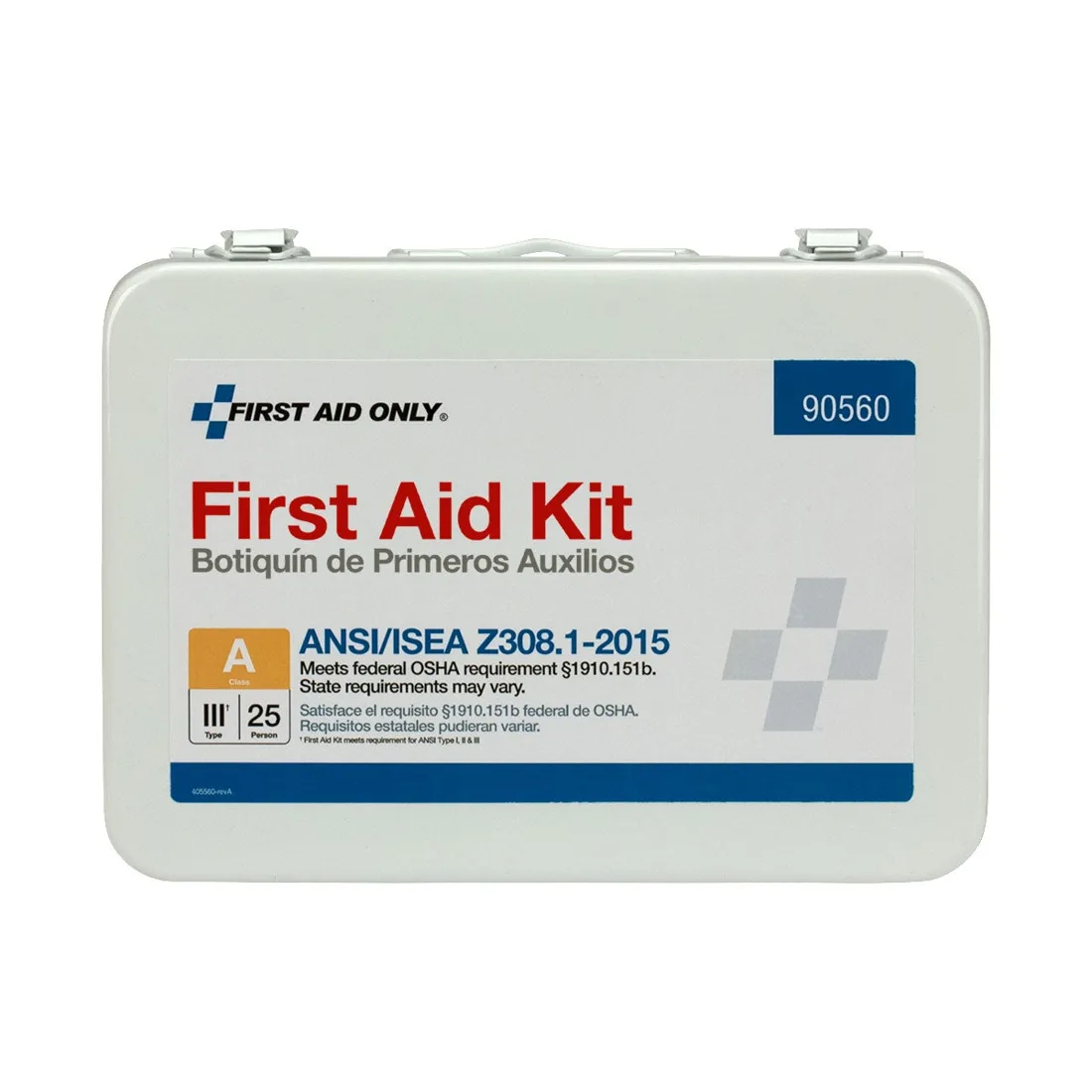
The kit pictured above shows why. Its label carries three different markers: a person count (25), a class (A) and a container type (III), alongside the edition of the US standard it was made to, ANSI/ISEA Z308.1-2015. The current edition is Z308.1-2021, which ISEA states took effect on 15 October 2022. A label can therefore be accurate for the edition it names and still not be the edition your safety team asks for.
ISEA's summary of the 2021 standard describes kit classes as Class A or Class B “based on workplace environment”, chosen through a hazard assessment, with item quantities set by the complexity of the work environment and level of hazards. It does not present the class as a headcount. If a buyer in the GCC is asked for an ANSI kit, record the class and edition requested, not just the person count.
References: ISEA: ANSI/ISEA Z308.1-2021 “Just the Facts” flyer
2. The same headcount can need a different kit size
In Abu Dhabi, ADOSH-SF Code of Practice 4.0 (version dated 15 July 2024) requires employers to carry out a health risk assessment to determine the number and contents of first aid kits. Its Appendix 1 includes a sizing table that links kit size to both employee numbers and risk level.
Under that table, a lower-risk workplace such as an office or shop uses a small kit for fewer than 25 employees, a medium kit for 25 to 100 and a large kit above 100. A higher-risk workplace such as construction, manufacturing or food processing moves up sooner: small for fewer than 5 employees, medium for 5 to 25 and large above 25. So 30 people in an office and 30 people on a fabrication floor do not point to the same kit.
This is an Abu Dhabi example, not a GCC-wide rule. Dubai, Saudi Arabia, Qatar and Oman have their own references, which are listed on the first aid kits page. Ask the person responsible for workplace safety to confirm which rule applies to each site before you translate it into a quantity.
References: ADOSH-SF Code of Practice CoP 4.0: First Aid and Medical Emergency Treatment (Version 4.0, 15 July 2024)
3. Count locations as well as people
A single kit rated for the full headcount is rarely the whole answer. ADOSH-SF CoP 4.0 says kits must be placed in all worksite vehicles, on every floor of office buildings and throughout the worksite as needed, in containers that can be reached easily and quickly. ISEA's summary makes a similar point: the proximity of supplies to each worker matters.
Before asking for a quotation, list where each kit will sit and how many people normally work near it on each shift. A three-floor office with 60 staff might reasonably need three floor kits and a vehicle kit, rather than one large cabinet in reception. Your safety lead decides the final layout; the purchasing brief just needs to record it clearly.
References: ADOSH-SF Code of Practice CoP 4.0: First Aid and Medical Emergency Treatment (Version 4.0, 15 July 2024) · ISEA: ANSI/ISEA Z308.1-2021 “Just the Facts” flyer
4. Compare contents lists, not labels
Two kits with the same person count can contain different items and quantities. The UK Health and Safety Executive describes its own list as a suggested contents list and says kit contents should be based on the first aid needs assessment. It also says a kit does not have to meet the British Standard BS 8599 by law. UK guidance does not apply to GCC sites, but the principle is a useful purchasing check: the contents list is what you are buying.
Ask each supplier for an itemised contents list per kit, with quantities, and compare it line by line against your approved list. Where a quoted kit falls short, ask for the missing items as a separate refill line instead of moving up to a bigger case. Where it includes extra items you do not need, ask whether a smaller or custom kit is available.
Keep the approved list with the order. ADOSH-SF CoP 4.0 also expects a competent person to inspect kits at least monthly and replace expired items, so the same list becomes your refill reference later.
References: UK HSE: What to put in your first aid kit · ADOSH-SF Code of Practice CoP 4.0: First Aid and Medical Emergency Treatment (Version 4.0, 15 July 2024)
5. Write the quote request around the site, not the label
Send the delivery country and city, workplace type and risk level, people per shift, and the list of kit locations, including vehicles. Attach the approved contents list, or say which code or standard the safety lead has asked for and which edition. Then ask the supplier to name the offered kit for each location and attach its contents list.
MedSphere's catalog includes kits from 5-person personal kits to 150-person stations, as well as OSHAD-style kits and custom kits built to a list. Prices, stock and delivery to the UAE, Saudi Arabia, Oman or Qatar are confirmed in the written quotation, not on the product page. The ABS first aid box listing is supplied empty; stocked contents must be requested separately.
Kit sizing brief
| Field | What to record |
|---|---|
| Site and rule | Country, city or emirate, and the code or standard your safety lead applies, including its edition. |
| Risk level | Lower or higher risk per area, as set by the site's risk assessment. |
| People per area | Normal headcount per floor, work area or shift, including contractors and visitors. |
| Kit locations | Each floor, work area and vehicle that needs its own kit. |
| Kit requested per location | Size or class required for each location, not one total for the site. |
| Contents list | Approved list with items and quantities; any optional items from the assessment. |
| Offered kit | Brand, model, stated person count, class and edition, with the supplier's itemised contents. |
| Gaps and refills | Missing items quoted as separate refill lines; expiry information requested. |
Questions before you order
Is a 50-person first aid kit enough for a site with 50 employees?
Not automatically. The person count is the manufacturer's description. The number, size and location of kits depend on the site's risk assessment and the rule that applies there; under Abu Dhabi's CoP 4.0 table, a higher-risk site with more than 25 employees already falls in the large-kit band.
What do Class A and Class B mean on an ANSI first aid kit?
They are classes under the US ANSI/ISEA Z308.1 standard, chosen by hazard assessment according to the workplace environment. Record the class and the edition (for example 2015 or 2021) your safety team asks for, because a label only refers to the edition it names.
Should I buy one large kit or several smaller kits?
Decide by location first. Codes such as ADOSH-SF CoP 4.0 expect kits on each office floor, in each worksite vehicle and across the worksite as needed, so a single large cabinet rarely covers a multi-floor or multi-area site on its own.
Can I order a kit to my own contents list?
Yes. Paste the approved list with quantities into the quotation form and say how many kits and locations you need. The quotation confirms what can be supplied, the case options and delivery terms.
Sources & scope
This is a purchasing guide. Your qualified safety lead should confirm the current requirements for your site. It is not a clinical protocol or a compliance certificate.
- ADOSH-SF Code of Practice CoP 4.0: First Aid and Medical Emergency Treatment (Version 4.0, 15 July 2024)
Abu Dhabi only. Used for Section 3.3 (risk assessment, kit placement, monthly inspection) and the Appendix 1 kit-size table by risk level and employee numbers. Not applied to other emirates or countries. Checked 27 October 2026.
- ISEA: ANSI/ISEA Z308.1-2021 “Just the Facts” flyer
US industry standard summary. Used for kit classes chosen by hazard assessment, the 15 October 2022 effective date and the point about proximity of supplies. Not a GCC legal requirement. Checked 27 October 2026.
- UK HSE: What to put in your first aid kit
UK guidance used only for the principle that contents follow a needs assessment, that its list is a suggestion and that BS 8599 is not legally required in the UK. Not applied as Gulf law. Checked 27 October 2026.
Prepared with AI assistance and checked against the cited sources. No clinical reviewer is claimed. Read our editorial policy or send a correction.
Explore the catalog
These products are available for enquiry. Specifications, contents and delivery are confirmed in your quotation.