
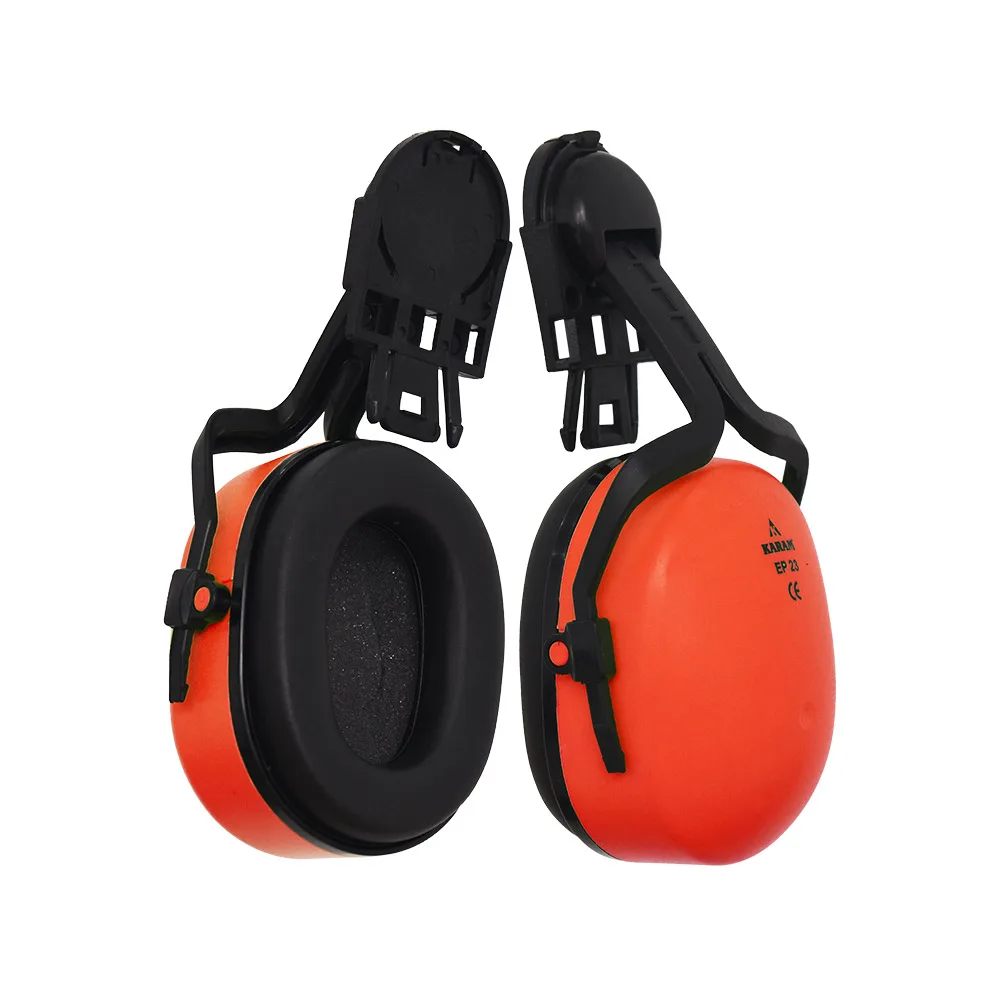
Start from the noise assessment, not the product. UK HSE guidance gives a simple table that matches a protector's SNR to the A-weighted noise level, and warns against over-protection below about 70 dB at the ear because workers then struggle to hear each other and warning signals. Then confirm the helmet: a helmet-mounted ear muff only works with helmets it is designed to clip onto, so send the helmet make and model with your order. Finally, plan upkeep and training: HSE says seals must be undamaged, headband tension kept, protection worn the whole time in the noisy area and users shown how to wear it with other PPE. The KARAM EP23 we list has a manufacturer SNR of 25 dB and a snap-on helmet mount.
Start with the noise level, then pick the SNR
Hearing protection is the last line of defence. HSE says it should not be used as an alternative to controlling noise by technical and organisational means, and that employers must provide protectors when exposure exceeds the upper exposure action value, and on request between the lower and upper values. Your safety lead or noise assessment sets the level for each area.
HSE then gives a guide table for choosing by SNR: 85 to 90 dB(A), an SNR of 20 or less; 90 to 95 dB(A), 20 to 30; 95 to 100 dB(A), 25 to 35; and 100 to 105 dB(A), 30 or more. It notes the table is a guide, not a substitute for the standardised calculation methods, and is not suitable where noise has significant low-frequency components, such as generators or plant rooms.
More is not always better. HSE says protectors that bring the level at the ear below 70 dB should be avoided, because over-protection makes communication and warning signals harder to hear. On a busy site, that is a safety risk of its own.
References: Health and Safety Executive (GOV.UK): Hearing protection
Confirm the helmet before ordering
Helmet-mounted muffs replace a headband with arms that clip into slots on the side of a safety helmet. KARAM describes the EP23 as designed for use with helmets, with an easy snap on and off mechanism, but its product page does not list which helmet models it fits.
So send the make and model of the helmets your workers already wear, or order helmets and muffs together. Ask the supplier to confirm in writing that the muffs fit that helmet and which adapter or clip is used, and test one set on site before a full order. HSE also asks employers to think about how hearing protection is worn with other PPE such as hard hats, dust masks and eye protection.
If some workers wear different helmets, list the quantities for each model so the right mounting parts are quoted.
References: KARAM Safety: Helmet attachable ear muffs EP23 · Health and Safety Executive (GOV.UK): Hearing protection
What to read on the specification
Take the rating from the manufacturer, not a reseller listing. KARAM’s page for the EP23 lists an SNR of 25 dB, ABS cups, a weight of 260 g and cushioned pads with a spring-loaded stand-off for the seal, and a one-year warranty against manufacturing defects from the invoice date.
The page gives a single SNR value and no H, M and L values. If your noise has a strong low-frequency component, ask for the full attenuation data before choosing, since HSE’s simple SNR table does not cover that case.
Weight matters on a long shift in the heat. Compare the weight of the muffs together with the helmet, and ask the workers who will wear them to try a sample.
References: KARAM Safety: Helmet attachable ear muffs EP23 · Health and Safety Executive (GOV.UK): Hearing protection
Upkeep, spares and training
HSE lists what to check: the protector is in good, clean condition, ear muff seals are undamaged, headband tension is not reduced and there are no unofficial modifications. On helmet-mounted muffs, check the clips and arms too, because they take knocks every time the helmet is put down.
Ask whether replacement cushions or hygiene kits are available for the model, and how quickly they can be supplied. KARAM’s EP23 page does not mention them, so confirm before you standardise on one model.
HSE also says protection should be worn at all times in a noisy environment, because removing it for even a few minutes considerably lowers the protection, and that users must be shown how to fit and use it, how to wear it with other PPE, how to check it and where to report damage. Put those points into your toolbox talk.
References: Health and Safety Executive (GOV.UK): Hearing protection · KARAM Safety: Helmet attachable ear muffs EP23
Helmet-mounted ear muff checklist
| Item | What to confirm |
|---|---|
| Noise level | A-weighted level per area from the noise assessment; note low-frequency sources. |
| SNR | Rating that matches the noise level without bringing the ear below about 70 dB. |
| Attenuation data | Full manufacturer data where noise is low-frequency or unusually high. |
| Helmet model | Make and model of each helmet in use, and quantities per model. |
| Mounting | Clip or adapter that fits that helmet, confirmed in writing; one test set first. |
| Weight and comfort | Weight of muffs plus helmet; wearer trial in site conditions. |
| Spares | Replacement cushions or hygiene kits, and lead time. |
| Checks | Who inspects seals, headband or arm tension and clips, and how often. |
| Training | Fitting, wearing with other PPE, checking and reporting damage. |
| Warranty | Term and what it covers, kept with the invoice. |
Questions before you order
What SNR do I need for helmet-mounted ear muffs?
It depends on the noise level. HSE’s guide table suggests an SNR of 20 to 30 at 90 to 95 dB(A) and 25 to 35 at 95 to 100 dB(A). Your noise assessment decides the level; avoid protectors that bring the ear below about 70 dB.
Do helmet ear muffs fit any safety helmet?
No. They fit helmets they are designed to clip onto. Send the helmet make and model, and ask for written confirmation of the fit and the clip or adapter used.
What is the SNR of the KARAM EP23?
KARAM lists 25 dB for the EP23, with a weight of 260 g and a one-year warranty against manufacturing defects.
Can workers lift the muffs off for a few minutes?
HSE says hearing protection should be worn at all times in a noisy area, because removing it even for a few minutes considerably lowers the protection.
Sources & scope
This is a purchasing guide. Your qualified safety lead should confirm the current requirements for your site. It is not a clinical protocol or a compliance certificate.
- Health and Safety Executive (GOV.UK): Hearing protection
UK HSE guidance, updated 13 January 2026. Used for when protectors must be provided, not using them instead of noise control, the SNR selection table and its limits, avoiding over-protection below 70 dB, wearing with hard hats and other PPE, condition checks, wearing at all times and training. UK guidance; follow your local authority's rules and your noise assessment. Checked 6 November 2026.
- KARAM Safety: Helmet attachable ear muffs EP23
Manufacturer product page (undated). Used for the 25 dB SNR, ABS material, 260 g weight, snap-on helmet mounting, cushioned seal and one-year warranty. It does not list compatible helmet models, H/M/L values or replacement cushions. Checked 6 November 2026.
Prepared with AI assistance and checked against the cited sources. No clinical reviewer is claimed. Read our editorial policy or send a correction.
Explore the catalog
These products are available for enquiry. Specifications, contents and delivery are confirmed in your quotation.