
If the fridge will hold medicines or vaccines labelled for 2–8 °C storage, quote a pharmacy or medical refrigerator, not a general single-door fridge. US CDC guidance ranks household units as the last option, for refrigerated vaccines only, and says never to use dormitory- or bar-style combined units. A Dubai Health Authority outpatient pharmacy checklist asks for a digital thermometer in the medication refrigerator, readings logged at least twice daily and back-up power for the refrigerator. Before ordering, confirm the capacity for your largest stock, the display and alarms, how temperatures are recorded, the voltage and where the unit will stand. A general fridge suits staff food and items with no controlled storage temperature on the label.
Start with what will go inside
List the items the fridge will hold and read the storage conditions on each label or leaflet. If any item says to store at 2–8 °C, the fridge is medicine storage and needs a controlled, monitored unit. Vaccines are the clearest case: the DHA outpatient pharmacy checklist requires vaccines to be kept in a separate refrigerator with temperature control between 2 and 8 °C.
If nothing on the list carries a controlled storage temperature, for example staff lunches, drinking water or general supplies, a general single-door fridge is enough. Our single-door fridges in 95, 122 and 225 litre sizes are general refrigerators and are not offered for vaccines.
Agree with your clinic lead or nurse that food and drink never share the medicine fridge. If the room needs both, quote two units rather than one larger one.
References: Dubai Health Authority: Final Checklist, Outpatient Pharmacies (HRS/HPSD/PG/01/2021)
How the unit types compare
The CDC page on vaccine storage units ranks the options. A unit that conforms to NSF/ANSI Standard 456 is preferred, purpose-built units are next because they are designed for vaccine storage, and pharmaceutical-grade units are third because they are engineered for pharmaceuticals or biologics. Household-grade units may be used only as a last option, and only for refrigerated vaccines.
The same page says never to use dormitory- or bar-style combined refrigerator/freezer units for vaccines, and never to store vaccines in the freezer compartment of a household combination unit, because of cold spots and temperature changes. It is US public health guidance, not Gulf law, but it explains why a small bar fridge is the wrong purchase for a site clinic.
Your regulator decides what your facility must use: DHA, DoH Abu Dhabi or MOHAP in the UAE, and the relevant ministry or authority in Saudi Arabia, Oman or Qatar. Ask your facility's licensed pharmacist or nurse in charge to confirm the requirement before you compare quotations.
References: CDC: Vaccine Storage Units
Size it for your largest stock, not your usual stock
CDC guidance says to use a unit with enough space for the maximum inventory without crowding, because crowding blocks the cold air and causes temperature swings. Size the fridge for your busiest month, such as a seasonal vaccination campaign or a delivery that arrives before the old stock is used.
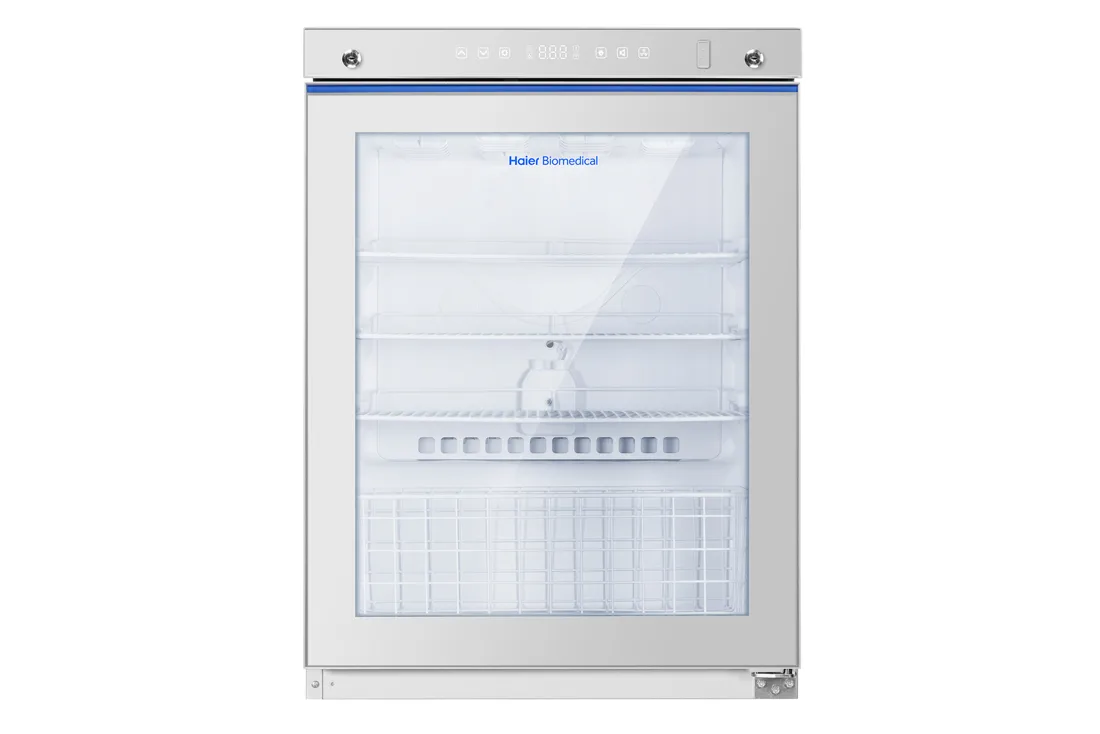
For example, a school nurse room holding a few prescribed medicines may only need a small unit such as the 68 litre Haier HYC-68A. An occupational health clinic that stores vaccines for a workforce campaign may need the 130 litre HYC-130GD or larger. Send the number and size of the boxes you store at peak, and we quote the size that fits.
Ask for the external dimensions and the door swing too, so the unit fits the room with space to open the door fully.
References: CDC: Vaccine Storage Units
Temperature display, records and alarms
Plan how temperatures will be recorded before the fridge arrives. The DHA outpatient pharmacy checklist (HRS/HPSD/PG/01/2021) asks for a digital thermometer in the medication refrigerator, temperature and humidity logged on a separate sheet at least twice daily, and back-up emergency power for the refrigerator. It also says a temperature monitoring system linked to a central alarm may be required. Clinics licensed by other regulators should check their own rules.
CDC says the only way to know a unit's temperature is to measure it with a temperature monitoring device, and to keep a back-up device to confirm readings if there could be a problem with the first one.
Features differ by model, so ask for them in writing. For its standard pharmacy refrigerator range, Haier Biomedical lists high and low temperature, sensor error, power failure and door ajar alarms, an LED display and USB data export as standard. That range is not the same as the models in our catalog, so the quotation confirms the display, alarms and data logger for the exact model offered.
References: Dubai Health Authority: Final Checklist, Outpatient Pharmacies (HRS/HPSD/PG/01/2021) · CDC: Vaccine Storage Units · Haier Biomedical: Standard Pharmacy Refrigerator range
Placement, power and the first days after delivery
CDC guidance asks for a well-ventilated room, at least 5 cm (2 in) of clearance from the ceiling and 2.5 to 5 cm (1 to 2 in) from adjacent walls, an unblocked motor compartment cover, and a level, stable unit. It recommends a room temperature of about 20 to 25 °C. Choose a spot away from direct sun and heat sources and tell us the room before delivery.
Confirm the socket and voltage with your facilities team, and how the fridge will be kept on back-up power if the DHA checklist or your own regulator requires it.
Do not stock a new unit on delivery day. CDC notes that a newly installed or repaired refrigerator may take 2 to 7 days to stabilise, so record the minimum and maximum temperatures each workday first and stock it once the readings stay in range.
References: CDC: Vaccine Storage Units · Dubai Health Authority: Final Checklist, Outpatient Pharmacies (HRS/HPSD/PG/01/2021)
Clinic and first aid room fridge checklist
| Item | What to confirm |
|---|---|
| Contents | Every item the fridge will hold and the storage temperature on its label. |
| Unit type | Pharmacy or medical refrigerator for 2–8 °C items; general fridge only for unregulated items. |
| Regulator | Which authority licenses the facility and what it requires for medicine fridges. |
| Capacity | Litres needed for peak stock without crowding; external size and door swing. |
| Temperature control | Set range, display type and how accurately it reads. |
| Alarms | High and low temperature, door ajar and power failure alarms on the exact model. |
| Records | Data logger or USB export, plus a separate back-up thermometer and a log sheet. |
| Power | Voltage, socket position and back-up power arrangement. |
| Placement | Ventilated room, wall and ceiling clearance, level floor, no direct sun. |
| Commissioning | Days of temperature readings before the first stock goes in. |
| Warranty | Term, what it covers and who services the unit in your emirate or country. |
Questions before you order
Can I keep vaccines in a normal fridge?
Avoid it. CDC guidance ranks household fridges as a last option for refrigerated vaccines only and says never to use bar- or dormitory-style combined units. The DHA outpatient pharmacy checklist requires vaccines in a separate refrigerator at 2–8 °C. Follow your own regulator's rules.
How often should the fridge temperature be recorded?
The DHA outpatient pharmacy checklist asks for readings logged at least twice daily. Other regulators may set different rules, so confirm yours with your pharmacist or nurse in charge.
Can I fill a new pharmacy fridge the day it arrives?
It is better not to. CDC says a new or repaired refrigerator may take 2 to 7 days to stabilise. Record the minimum and maximum temperatures first and stock it once they stay within 2–8 °C.
Do you confirm the data logger, voltage and warranty before I order?
Yes. Send the room, the stock you will store and your power supply, and the quotation confirms the model, voltage, data logger and warranty in writing.
Sources & scope
This is a purchasing guide. Your qualified safety lead should confirm the current requirements for your site. It is not a clinical protocol or a compliance certificate.
- CDC: Vaccine Storage Units
US Centers for Disease Control and Prevention guidance, reviewed 14 July 2026. Used for the ranking of unit types (NSF/ANSI 456, purpose-built, pharmaceutical-grade, household as last option), never using dormitory- or bar-style units or household freezer compartments, the 2–8 °C range, sizing without crowding, temperature monitoring devices and back-ups, room placement and clearances, and the 2–7 day stabilisation period. US guidance; not a UAE or GCC requirement. Checked 4 November 2026.
- Dubai Health Authority: Final Checklist, Outpatient Pharmacies (HRS/HPSD/PG/01/2021)
Inspection checklist hosted on dha.gov.ae, referencing the DHA Pharmacy Guideline 2021. Used for vaccines in a separate refrigerator at 2–8 °C, a digital thermometer in the medication refrigerator, temperature and humidity logged at least twice daily, a possible central alarm system, and back-up power. Applies to DHA-licensed outpatient pharmacies; other facilities follow their own regulator. Checked 4 November 2026.
- Haier Biomedical: Standard Pharmacy Refrigerator range
Manufacturer page for the HYC-410, HYC-610, HYC-639 and HYC-1378 range. Used only as an example of features to ask about (temperature, sensor, power failure and door ajar alarms, LED display, USB export). It does not cover the HYC-68A or HYC-130GD; their features are confirmed in the quotation. Checked 4 November 2026.
Prepared with AI assistance and checked against the cited sources. No clinical reviewer is claimed. Read our editorial policy or send a correction.
Explore the catalog
These products are available for enquiry. Specifications, contents and delivery are confirmed in your quotation.