
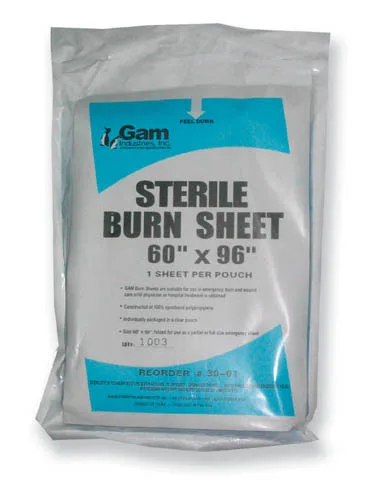
A sterile burn sheet is for covering a large burn after it has been cooled, not for cooling it. UK first aid guidance from the NHS, the British Burn Association (BBA) and the British Red Cross starts with cool running water for 20 minutes, then a loose covering such as cling film; the BBA also lists any clean lint-free cloth or a non-adherent dressing, and says to keep the casualty warm because large burns can lead to hypothermia. A 60 × 96 in sheet suits sites where a burn may cover a large area of the body, such as plants with hot processes, fire teams and remote oil and gas sites. Stock it next to a water supply and cling film, in its sealed pouch, and confirm brand, material and packing in the quotation.
Cooling comes first; the sheet comes after
The NHS says to hold a burn or scald under cool running water for 20 minutes, starting as soon as possible and within 3 hours, and to use cool bottled water or a wet towel if there is no running water. It says to remove clothing or jewellery near the burn, but not anything stuck to it.
The BBA first aid guideline (dated 24 September 2018) gives the same 20 minutes within 3 hours, and says not to use ice or iced water. Where no water is available, it says to cover the burn with cling film and cool it at the first opportunity within 3 hours.
So a burn sheet does not replace water. Before buying sheets, check that every area with a burn hazard has a tap, a drench shower or enough bottled water for 20 minutes of cooling.
References: NHS: Burns and scalds · British Burn Association: First Aid Clinical Practice Guideline (24 September 2018)
Cover loosely and keep the casualty warm
The NHS says to lay cling film over the burn and not wrap it around. The British Red Cross says to cover it loosely with cling film or a clean plastic bag and not to use adhesive bandages. The BBA lists loose strips of cling film, any clean lint-free cloth or a non-adherent dressing, and says not to wrap cling film around limbs or use it on facial burns.
The BBA’s phrase is “cool the burn but warm the patient”. It warns that cooling beyond 20 minutes may cause hypothermia, especially in children, older people and large burns, and asks first aiders to cover unburned areas during cooling. The Red Cross also warns against putting the whole body under a cold shower or in a cold bath.
This is where a large sheet earns its place: after cooling, a casualty with burns over a large area needs a clean covering for the burn and something to keep the rest of the body warm. Stock blankets or foil blankets with the burn sheets, and agree with your medical lead how your first aiders use them.
References: NHS: Burns and scalds · British Burn Association: First Aid Clinical Practice Guideline (24 September 2018) · British Red Cross: First aid for burns
Which sites need large burn sheets
Most workplace burns are small and need water and a small covering. The large sheet is for sites where a burn could cover much of the body: plants with furnaces, hot oil or steam, fire and rescue teams, oil and gas fields, and offshore installations where evacuation takes time.
The NHS says to call 999 or go to A&E for burns that are very large or deep, on the face, genitals or bottom, or caused by chemicals or electricity, and not to drive to A&E. In the UAE and GCC, put your local emergency number on the burn kit and in the site emergency plan.
Do not add creams to the kit for this purpose. The NHS says not to put creams, oils or butter on burns, not to use plasters or sticky dressings and not to burst blisters. If you stock burn gel dressings, our guide on ordering them covers sizes and packs.
References: NHS: Burns and scalds
What to check when ordering
Burn sheets are sold in different sizes, so check the size on the quotation; we list a 60 × 96 in sheet. Listings we read describe sheets packed one per sealed sterile pouch, folded so they can be used as a partial or full-size covering, and made of lint-free non-woven material. Confirm the brand, material and pack count for your order.
Sterile only means something while the pouch is intact. Store sheets flat in a dry box, check pouches for tears at each kit inspection and replace any that are damaged or past their expiry date.
Record the lot number at delivery. In 2017 Dukal Corp. recalled specific lots of 60 × 96 in blue burn sheets after intact cartons were found to contain shredded sheets; the FDA lists it as a Class 2 recall, terminated in 2018. Lot records let you act quickly if a supplier issues a notice.
References: U.S. FDA: Class 2 device recall, blue burn sheet, sterile, 60 × 96 in (Z-0233-2018) · Retailer listing: DMI GAM sterile burn sheet (650-3001-0100)
Burn sheet stocking checklist
| Item | What to confirm |
|---|---|
| Burn hazards | Areas where a burn could cover a large part of the body. |
| Cooling water | Tap, drench shower or bottled water for 20 minutes at each area. |
| Covering | Cling film for small burns; large sterile burn sheets where needed. |
| Warmth | Blankets or foil blankets kept with the burn sheets. |
| Size | Sheet size on the quotation, for example 60 × 96 in. |
| Pack | One sheet per sealed sterile pouch; brand and material confirmed. |
| Storage | Flat, dry, pouch intact; expiry date checked at each inspection. |
| Lot record | Lot number logged at delivery. |
| Emergency plan | Local emergency number and when to call, on the kit. |
| Training | First aiders trained on cool, cover and keep warm. |
Questions before you order
Can a burn sheet be used instead of cooling with water?
No. The NHS, BBA and British Red Cross all say to cool a burn under running water for 20 minutes. The covering goes on after cooling.
Is cling film acceptable for covering a burn?
Yes, the NHS and Red Cross say to lay cling film loosely over the burn. The BBA says not to wrap it around limbs or use it on the face.
Why keep blankets with burn sheets?
The BBA says to cool the burn but keep the patient warm, because long cooling and large burns can lead to hypothermia.
Which workplaces need large sterile burn sheets?
Sites where a burn could cover much of the body: plants with hot processes, fire and rescue teams, oil and gas fields and offshore installations.
What should I check when burn sheets are delivered?
Size, an intact sealed pouch, the expiry date and the lot number. Log the lot so you can act on any recall notice.
Sources & scope
This is a purchasing guide. Your qualified safety lead should confirm the current requirements for your site. It is not a clinical protocol or a compliance certificate.
- NHS: Burns and scalds
NHS page, last reviewed 31 March 2026. Used for 20 minutes of cool running water within 3 hours, removing clothing and jewellery, cling film laid over the burn, what not to apply and when to call 999. UK guidance; use your local emergency number. Checked 15 November 2026.
- British Burn Association: First Aid Clinical Practice Guideline (24 September 2018)
BBA pre-hospital guideline. Used for stop, remove, cool, warm, cover; 20 minutes within 3 hours; no ice; hypothermia risk; covering unburned areas; cling film strips, lint-free cloth or non-adherent dressing; no cling film around limbs or on the face. A newer BBA first aid statement (August 2026) was not read. Checked 15 November 2026.
- British Red Cross: First aid for burns
Charity first aid page (undated). Used for at least 20 minutes of cooling, loose cling film or a clean plastic bag, no adhesive bandages and the warning against cold baths or showers. Checked 15 November 2026.
- U.S. FDA: Class 2 device recall, blue burn sheet, sterile, 60 × 96 in (Z-0233-2018)
FDA recall database entry for Dukal Corp. item 7305, GAM item 30-01; reason: shredded sheets in intact cartons; initiated June 2017, terminated July 2018. Used to show why lot records matter. US record. Checked 15 November 2026.
- Retailer listing: DMI GAM sterile burn sheet (650-3001-0100)
Third-party retailer listing (undated). Used only for the lint-free non-woven material, the individual sterile pouch and folding for partial or full-size use. The stock we quote may differ. Checked 15 November 2026.
Prepared with AI assistance and checked against the cited sources. No clinical reviewer is claimed. Read our editorial policy or send a correction.
Explore the catalog
These products are available for enquiry. Specifications, contents and delivery are confirmed in your quotation.