
Start from the storage conditions printed on the medicines and supplies you keep, not from the device. NHS Specialist Pharmacy Service guidance says most medicines may be stored up to 25 °C, some up to 30 °C, and that the label or product information sets the limit. Then choose a thermo-hygrometer that shows the current reading and the minimum and maximum since it was last reset, with an alert if you need one, and a calibration certificate if your regulator or policy asks for it. The DHA outpatient pharmacy checklist asks for temperature and humidity to be logged at least twice daily. Before buying the Extech RH30, note that its manual describes it as for home use, not medical practices, and the manufacturer lists it as discontinued, so confirm the current model in the quotation.
Start with the limits on the labels
NHS Specialist Pharmacy Service (SPS) guidance says most medicines are stored at room temperature, and that packs express this in different ways, such as between 15 and 25 °C or below 30 °C. It says most medicines may be stored up to 25 °C, some allow up to 30 °C, and storage information can differ between brands of the same medicine.
Before ordering a monitor, list what the room holds: first aid kit refills, creams, tablets, test strips, dressings and anything the clinic stocks. Note the lowest maximum temperature among them. In a Gulf summer, a first aid room without reliable air conditioning can pass 30 °C, so the room itself may need fixing before any monitor helps.
Items labelled 2–8 °C belong in a monitored medicine fridge, not on a room shelf. Our guide on pharmacy refrigerators covers that choice.
References: NHS Specialist Pharmacy Service: Understanding why temperature management is important for medicines storage · NHS Specialist Pharmacy Service: Managing temperature excursions
What the device needs to do
A reading taken at 9 am says little about the afternoon. SPS describes a min/max recorder as recording the lowest and highest temperatures since it was last reset, and notes that a continuous data logger gives a more detailed picture than a min/max recorder. For a staffed first aid room, min/max memory read and reset at each check is the practical minimum; for a medicine store, ask whether a logger is expected.
If humidity matters, for example where your regulator asks for it or where test strips and dressings are stored, choose a device that reads relative humidity as well. The DHA outpatient pharmacy checklist asks for temperature and humidity to be logged on a separate sheet at least twice daily.
Ask for the accuracy statement and whether a calibration certificate can be supplied with the unit. Our catalog lists the exact model, min/max memory and calibration certificate as items we confirm in the quotation.
References: NHS Specialist Pharmacy Service: Managing temperature excursions · Dubai Health Authority: Final Checklist, Outpatient Pharmacies (HRS/HPSD/PG/01/2021)
What the Extech RH30 does, and its limits
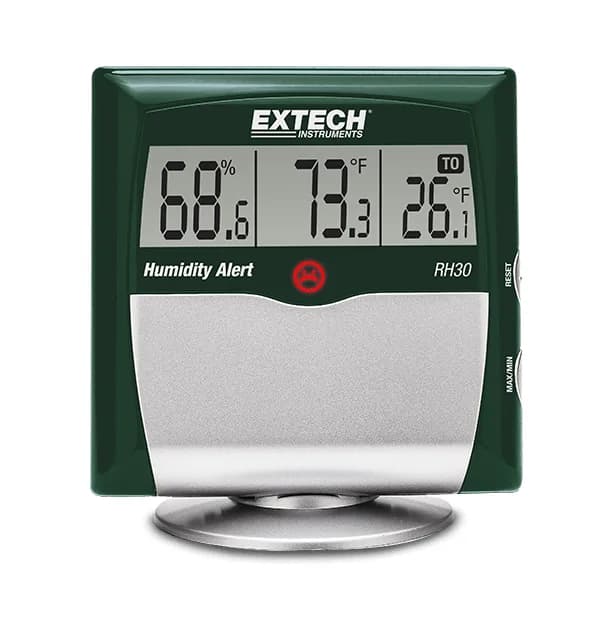
The RH30 manual describes a portable hygro-thermometer that shows relative humidity, temperature and dew point, with temperature accuracy of ±1.0 °C and humidity accuracy of ±4% between 35 and 75% RH, otherwise ±5%. It stores maximum and minimum readings, which are cleared with the RESET button, and a rear switch selects °C or °F.
Its humidity alert is set by a rear switch to 55, 60 or 65% RH. Above that level it sounds a tone and shows a symbol, and an arrow stays on afterwards to show the limit was passed. There is no temperature alarm. It runs on two AA batteries and can stand on a desk or hang on a wall.
The same manual says the RH30 is intended for home use only and not for medical practices, and the RH30 page on FLIR’s website lists it as discontinued, with a 2-year warranty. For a licensed clinic or pharmacy, ask for a current model whose manufacturer states it is suitable for that use, and confirm it in writing.
References: Extech (FLIR): RH30 hygro-thermometer with humidity alert, product page and user guide
Records, placement and what to do when it goes out of range
Place the sensor where the stock is, away from direct sun, air conditioning outlets and windows, and check that it is working. SPS asks you to check that temperature sensors are in the right place and working correctly.
Record the current, minimum and maximum readings, the time and who checked, then reset the memory. Keep the log with the room’s inspection card so a missed check is visible.
If a reading is out of range, SPS advises fixing obvious causes, putting the affected stock in quarantine with a do-not-use label, and documenting every excursion however minor, with batch numbers and the advice taken. It does not ask for automatic disposal: the pharmacist or the product information decides whether stock can still be used. Agree in advance who your staff call.
References: NHS Specialist Pharmacy Service: Managing temperature excursions
Thermo-hygrometer checklist
| Item | What to confirm |
|---|---|
| Label limits | Lowest maximum storage temperature among the items in the room. |
| Fridge items | 2–8 °C items moved to a monitored medicine fridge. |
| Readings | Temperature and, if required, relative humidity. |
| Memory | Min/max memory with reset, or a data logger for medicine stores. |
| Alerts | Temperature or humidity alert levels you need, and whether they are adjustable. |
| Accuracy and calibration | Stated accuracy; calibration certificate if your policy or regulator asks. |
| Suitability | Manufacturer states the model is suitable for a clinic or pharmacy where required. |
| Placement | Near the stock, away from sun, vents and windows. |
| Log | Current, min and max readings, time, initials; frequency set by policy. |
| Excursions | Quarantine label, who to call, how incidents are recorded. |
Questions before you order
What temperature should a first aid room or medicine store be kept at?
Follow the labels. NHS SPS guidance says most medicines may be stored up to 25 °C and some up to 30 °C, and the product information sets the limit for each brand.
Do I need a thermo-hygrometer or just a thermometer?
If your regulator or policy asks for humidity, you need both readings. The DHA outpatient pharmacy checklist asks for temperature and humidity to be logged at least twice daily.
Is the Extech RH30 suitable for a clinic?
Its manual describes it as intended for home use only, not medical practices, and the manufacturer lists it as discontinued. Ask for a current model rated for clinical use.
What should staff do if the room goes over the limit?
SPS advises fixing obvious causes, quarantining affected stock with a do-not-use label, recording the excursion and asking a pharmacist whether the stock can still be used.
Can you supply a thermo-hygrometer with a calibration certificate?
Tell us where it will be used and whether you need a certificate or data logger, and we confirm the model, certificate and warranty in the quotation.
Sources & scope
This is a purchasing guide. Your qualified safety lead should confirm the current requirements for your site. It is not a clinical protocol or a compliance certificate.
- NHS Specialist Pharmacy Service: Understanding why temperature management is important for medicines storage
NHS SPS article, published 10 November 2022, last updated 27 August 2026. Used for room-temperature storage, how packs express limits and storing medicines as their packaging directs. UK guidance; follow your own regulator. Checked 11 November 2026.
- NHS Specialist Pharmacy Service: Managing temperature excursions
NHS SPS article, published 10 November 2022, last updated 9 July 2024. Used for the 25 °C and 30 °C limits, brand differences, min/max recorders and data loggers, sensor placement checks, quarantine, documentation and seeking advice. UK guidance; follow your own regulator. Checked 11 November 2026.
- Dubai Health Authority: Final Checklist, Outpatient Pharmacies (HRS/HPSD/PG/01/2021)
Inspection checklist hosted on dha.gov.ae. Used only for temperature and humidity logged on a separate sheet at least twice daily. Applies to DHA-licensed outpatient pharmacies; other facilities follow their own regulator. Checked 4 November 2026.
- Extech (FLIR): RH30 hygro-thermometer with humidity alert, product page and user guide
Manufacturer product page (marked discontinued, 2-year warranty) and the RH30 user guide v1.5 (7/15). Used for the measured values, accuracy, min/max memory and reset, 55/60/65% RH alert switch, °C/°F switch, AA batteries, mounting and the home-use-only statement. Checked 11 November 2026.
Prepared with AI assistance and checked against the cited sources. No clinical reviewer is claimed. Read our editorial policy or send a correction.
Explore the catalog
These products are available for enquiry. Specifications, contents and delivery are confirmed in your quotation.