
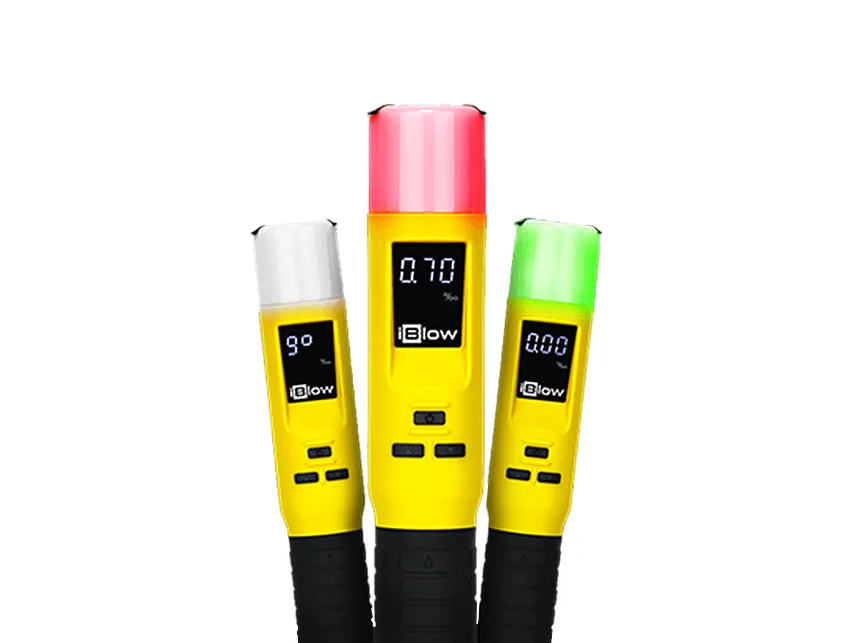
Decide first what the device is for: occasional personal checks or repeated screening at a gate or shift change. Then compare the sensor type, the calibration interval and what happens when it is due, the mouthpiece or blow cap and how many you need, how fast it can test, the operating temperature for your site, and the warranty. The two Sentech devices we list show the difference. The ALCOSCAN AL7000 manual describes an oxide semiconductor sensor with a pre-calibrated module replaced after about 300 tests. The iBlow10 manual describes a fuel cell sensor, up to 12 tests a minute and a factory default calibration of every 5,000 tests or 12 months, after which the unit locks. A screening device does not replace your alcohol policy, which your HR and safety leads own.
Start with how often you will test
A pocket tester used a few times a week and a screener used at every shift change are different purchases. Count the tests you expect per day and per year, the number of locations, and whether testing is random, for cause or for everyone at entry. That number decides the sensor, the calibration cost and the consumables.
Write down who will run the tests and where the result is recorded. The device gives a reading; your written policy decides what happens next, who confirms a positive screen and how the record is kept. Have HR and your safety lead agree the policy before choosing a model.
Semiconductor or fuel cell sensor
Check the sensor type in the manual, not only on the box. The ALCOSCAN AL7000 user’s manual describes an oxide semiconductor sensor with a range of 0.000 to 0.400% BAC and an accuracy of ±0.01% BAC up to 0.10% BAC. The iBlow10 user manual describes a fuel cell sensor made with Sentech Korea’s SURACELL technology.
Alcolizer Technology, a maker of fuel cell breathalyzers, says semiconductor sensors need frequent calibration and degrade faster, and that fuel cell sensors hold calibration longer. Treat that as a manufacturer’s view, and weigh it against your test volume: a low-volume personal check and a gate screener do not need the same device.
Whichever you choose, ask for the measuring range and accuracy statement for the exact model in writing, and the units it displays. The AL7000 manual lists % BAC, ‰ and mg/L BrAC options.
References: ALCOSCAN AL7000 user’s manual · Sentech Korea: SURACELL iblow 10 user manual · Alcolizer Technology: Breathalyser accuracy and reliability
Calibration: interval, lock and who does it
Calibration is a running cost, so ask for it before comparing prices. The iBlow10 manual gives a factory default of every 5,000 tests or 12 months, whichever comes first, changeable with the web-server software. When it passes that point a grace period starts, and after the grace period the device locks and must be recalibrated by a service provider before it works again.
The AL7000 takes a different approach. Its manual describes pre-calibrated sensor modules that the user snaps out and replaces, at about 300 tests or if the sensor is damaged, and the device shows a “CAL” warning past 300 tests. Ask what a replacement module costs and how quickly one can be supplied.
For either type, ask whether the unit arrives with a calibration certificate, what date it starts from, and who in your country recalibrates it. Our catalog lists calibration status on delivery as an item we confirm in the quotation.
References: Sentech Korea: SURACELL iblow 10 user manual · ALCOSCAN AL7000 user’s manual
Mouthpieces, blow caps and test speed
Consumables decide how a device works at a queue. The AL7000 uses separate MP1000 mouthpieces, and its manual lists five in the box, so order mouthpieces in line with the number of people you will test. We list mouthpieces for Alcoscan devices separately.
The iBlow10 manual describes a replaceable, washable blow cap for hygienic use, a passive test mode and up to 12 tests per minute, which is the reason it is used at shift changes and gates. Agree who cleans or swaps the cap between sessions and how many spare caps you hold.
Both manuals say to wait at least 20 minutes after eating or drinking, including alcohol-based mouthwash, before testing, and not to blow smoke or saliva into the device. Put that waiting time into your testing procedure so a screen is not repeated unnecessarily.
References: ALCOSCAN AL7000 user’s manual · Sentech Korea: SURACELL iblow 10 user manual
Operating temperature, power and warranty
Check the operating temperature against where the device will be used. The AL7000 manual gives 10 to 40 °C. The iBlow10 manual shows a low-temperature error below −5 °C and a high-temperature error above 50 °C. An outdoor gatehouse in a Gulf summer can exceed the range of some devices, so store it inside between tests if needed.
The iBlow10 runs on six AA alkaline or rechargeable batteries, according to our catalog. Ask how many tests a set lasts and keep spares at each test point.
Both manuals give a six-month manufacturer warranty against defects in workmanship or material, excluding calibration. Ask the supplier what local support and repair route applies, and keep the proof of purchase with the calibration record.
References: ALCOSCAN AL7000 user’s manual · Sentech Korea: SURACELL iblow 10 user manual
Workplace breathalyzer purchasing checklist
| Item | What to confirm |
|---|---|
| Use and volume | Personal checks or screening; tests per day and per year; number of test points. |
| Policy | Written alcohol policy, who runs tests, who confirms a positive screen and how results are recorded. |
| Sensor | Semiconductor or fuel cell, as stated in the manual of the exact model. |
| Range and units | Measuring range, accuracy statement and display units. |
| Calibration | Interval in tests and months, grace period or lock, certificate on delivery, local recalibration route. |
| Sensor module | For module-type devices: replacement interval and module availability. |
| Mouthpiece or cap | Mouthpiece type and quantity, or blow cap cleaning and spares. |
| Test speed | Tests per minute and passive mode, if testing a queue. |
| Environment | Operating temperature against the test location; storage between uses. |
| Power | Battery type, tests per set and spares at each point. |
| Warranty | Term, what it excludes (such as calibration) and the repair route. |
Questions before you order
Is a fuel cell breathalyzer better than a semiconductor one?
Fuel cell maker Alcolizer says fuel cell sensors hold calibration longer, which matters for frequent screening. Low-volume personal checks can use a semiconductor device such as the AL7000, which replaces its pre-calibrated sensor module after about 300 tests.
How often does an iBlow10 need calibrating?
Its manual gives a factory default of every 5,000 tests or 12 months, whichever comes first. After a grace period the device locks until it is recalibrated by a service provider.
How long should someone wait after eating or drinking before a test?
Both the AL7000 and iBlow10 manuals say at least 20 minutes, including after alcohol-based mouthwash.
Do you quote mouthpieces and calibration with the device?
Yes. Send the model, how many tests you expect and where you test, and we quote the device, mouthpieces or caps and calibration status as separate lines.
Sources & scope
This is a purchasing guide. Your qualified safety lead should confirm the current requirements for your site. It is not a clinical protocol or a compliance certificate.
- Sentech Korea: SURACELL iblow 10 user manual
Manufacturer user manual (undated), read on a third-party manuals site. Used for the fuel cell sensor, factory default calibration of 5,000 tests or 12 months, grace period and calibration lock, blow cap, passive test, 20-minute wait, temperature errors and six-month warranty excluding calibration. Confirm against the manual supplied with your unit. Checked 5 November 2026.
- ALCOSCAN AL7000 user’s manual
Device user’s manual (undated; publisher not named in the file), hosted by a retailer. Used for the oxide semiconductor sensor, range and accuracy, pre-calibrated sensor modules replaced at about 300 tests, five mouthpieces in the box, 20-minute wait, 10–40 °C operating temperature and six-month warranty excluding calibration. Confirm against the manual supplied with your unit. Checked 5 November 2026.
- Alcolizer Technology: Breathalyser accuracy and reliability
Manufacturer article (published 2024-10-14, modified 2026-09-10) written for Australian workplaces by a fuel cell device maker. Used only for its explanation of semiconductor and fuel cell sensors and calibration stability. Checked 5 November 2026.
Prepared with AI assistance and checked against the cited sources. No clinical reviewer is claimed. Read our editorial policy or send a correction.
Explore the catalog
These products are available for enquiry. Specifications, contents and delivery are confirmed in your quotation.